
Pedagogical Approach
At Hagley Theatre School, learning is a journey into the principles of acting and theatre-making. We encourage students to connect with the creative, playful, and transformative body. This experience is deepened through core disciplines such as Self-Creation, Voice, Acrobatics, and Kapa Haka training, which foster confidence on and off the stage and form the foundation of weekly practice.
From this foundation, students are introduced to specialised areas of performance practice — mask work, clown, bouffon, melodrama, tragedy, and chorus — each expanding the actor’s expressive range and offering powerful tools for both performance and creation. Hagley Theatre School is a place to explore technique, take creative risks, develop original work, and discover their unique artistic voice.

At Hagley Theatre School, learning is a journey into the principles of acting and theatre-making. We encourage students to connect with the creative, playful, and transformative body. This experience is deepened through core disciplines such as Self-Creation, Voice, Acrobatics, and Kapa Haka training, which foster confidence on and off the stage and form the foundation of weekly practice.
From this foundation, students are introduced to specialised areas of performance practice — mask work, clown, bouffon, melodrama, tragedy, and chorus — each expanding the actor’s expressive range and offering powerful tools for both performance and creation. Hagley Theatre School is a place to explore technique, take creative risks, develop original work, and discover their unique artistic voice.

Neutral Mask
Training begins with the Neutral Mask — an “awakening” of the body’s poetic potential. Students rediscover the world through movement, observing how nature, objects, and everyday life unfold through actions and reactions. Neutral Mask work develops body awareness, presence in space, and an understanding of physical action as the basis of theatrical play.
It reveals the underlying story or conflict carried within each body and helps the performer find clarity, silence, and neutrality before narrative emerges. Through this practice, students uncover rhythms, forms, gestures, and dynamics that shape the foundation of their expressive range.
Larval Masks
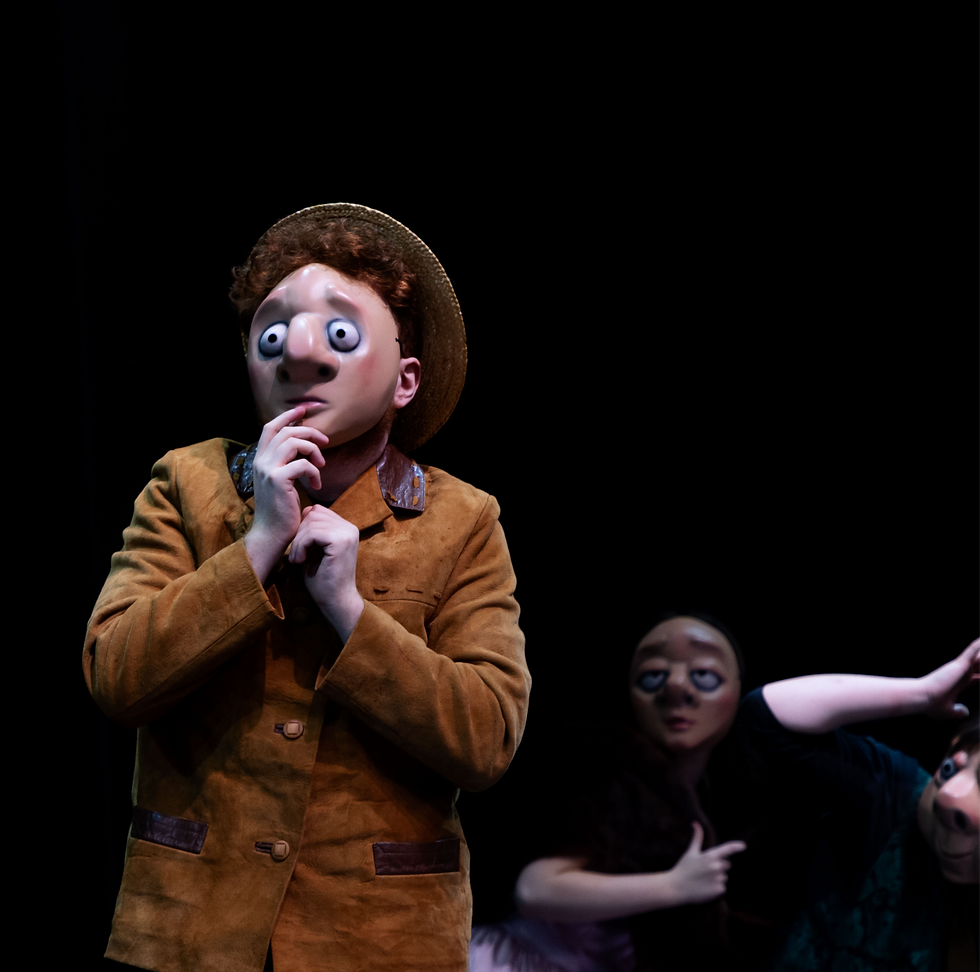
Larval masks are oversized, simplified face forms that capture characters in an early stage of development not yet fully human, but full of potential. Their function is to train performers to amplify physical expression, using minimal gestures with maximum clarity. With no fixed age, gender, or psychology, they invite curiosity, playfulness, and discovery. Their broad shapes, limited features, and strong lines demand slow, precise movement, helping students access a state of wonder, openness, and imaginative exploration.

Larval Masks
Larval masks are oversized, simplified face forms that capture characters in an early stage of development not yet fully human, but full of potential. Their function is to train performers to amplify physical expression, using minimal gestures with maximum clarity. With no fixed age, gender, or psychology, they invite curiosity, playfulness, and discovery. Their broad shapes, limited features, and strong lines demand slow, precise movement, helping students access a state of wonder, openness, and imaginative exploration.
Expressive Masks
Expressive full masks present fully formed characters with defined emotions, intentions, and rhythms. Their function is to guide actors toward precise physical embodiment, as every gesture must serve the mask’s clear emotional logic. With strong features, dynamic expressions, and fixed psychological states, they demand committed, economical movement. Pedagogically, expressive masks train students to externalize character, sharpen physical storytelling, and inhabit bold theatrical archetypes, developing presence, clarity, and a fully embodied performance style grounded in physical truth.
Half masks occupy a unique place at HTS training, exposing the mouth and voice while shaping the eyes and brow into a fixed dramatic form. They invite actors to unite physical specificity with spoken text, expanding the interplay between gesture, rhythm, and vocal presence. Their sculpted features offer strong character clues, yet leave room for expressive nuance. As a learning tool, half masks cultivate clarity of intention, sharpen the actor’s focus, and strengthen the integration of body, breath, and imagination in performance.
Half Masks


Clown
The pedagogical journey next step is the exploration of the sublime and the grotesque through the clown’s red nose and bouffon. The study of comedy, the actor’s game rules, and joyful failure expands the pedagogy of masks and opens the door to ridiculousness and self-acceptance. Through the clown’s red nose, students grasp the dramaturgy of laughter and its bond with the audience. The clown’s fall becomes a metaphor for the examination of one’s persona and rediscovering the inner child. The pedagogy of innocence unveils infinite possibilities and theatre’s structure in its purest simplicity. A clown is not a character; it is a performer embracing absolute sincerity and vulnerability without any shield.
Bouffon
Bouffon is a modern French theatre term for a distinct comedic style centred on mockery, parody, and satire. Bouffons laugh at everyone, and nothing is taboo or off-limits, as they hold a mirror to societal norms and institutions: religion, sexual mores, family, gender, education, politics, morality, and death are mocked effortlessly, provided a deeper truth emerges—this is its essence. Bouffons are immortal, representing society’s elements in amplified, distorted, or exaggerated forms, provoking laughter and outrage. The bouffon embodies society’s outcasts, with nothing to lose. Their delight is blasphemy, sparing nothing from their piercing gaze and mischievousness.


Melodrama
Melodrama offers student actors further chances to explore the significance of heightened theatricality. It also deepens the study of the link between physicality and characters’ emotional states such as affliction, remorse, resentment, shame, and revenge. The aim is to deliver a performance so powerful that spectators are moved to tears. Actors achieve this only by believing in everything with utmost conviction: sacrifice, the clash of good versus evil, courage versus cowardice, and morality versus justice. Through Melodrama, students encounter archetypal gestures of the villain, hero, and victim. Gestures and space become the geometry of emotion. Melodrama is not outdated; it surrounds us daily—in losing a job, in families struck by war, or immigrants forced to leave their homeland.
The pedagogical journey concludes with the antithesis of the clown: The Hero. While the clown delights in falling and failing, the hero resists the fall and battles against the fate of gods and nature. The study of the chorus and the hero connect all pedagogical areas. It is the most significant theatre style, addressing drama in its loftiest form. From the tragic chorus and spatial dynamics, the hero emerges to confront existence with confidence and arrogance. Tragedy is vertical (above are gods, below is death) and expresses the universe’s great questions and our tragic condition. We are godlike, yet not gods. While the hero fights the impossible, clowns embrace the tragic, and bouffons laugh at it all.
Tragedy
